

States We Lend In
Our loan officers are ready and waiting to help you apply for your home loan.


If you’re considering buying a home in Denver, you’re probably a little overwhelmed by all the moving parts that go into applying for a mortgage and closing on a house. It can be tempting to look for a Denver mortgage broker and hope they can handle everything for you.
While using an online broker to hook you into the world of real estate lending seems like an easy answer to your homebuying challenges, there are some things you should know about Denver mortgage brokers before taking this route. You have plenty of choices when it comes to applying online for a home loan, and a mortgage broker in Denver is only one option.
Mortgage brokers are above all loan originators. They want to “sell” you a loan, and it may or may not be a good deal for you. Most mortgage brokers are well educated and hold a bachelor’s degree in a field like accounting, finance, or business.
Mortgage brokers must be bonded, and have to pass the National Mortgage License System (NMLS) Loan Originator exam. Depending on the state(s) they work in, they may also have business license and have taken a certification course or pre-licensure program.
What a mortgage broker is not: an actual lender. Mortgage brokers are matchmakers, pairing off would be borrowers with lenders they see as the best fit, whether that’s a big bank, a local credit union, or an online lender.
Independent mortgage broker work for themselves and with a network of lenders. Mortgage brokerages typically have a number of brokers working for them and benefitting from their advertising. Brokers gather information (and possibly documentation) from you and share it with prospective lenders. They may work with an underwriter o the lender side to help get your loan approved and funded, but they don’t set interest rates working with underwriters to get loans approved. However, they don’t fund any loans or act as a lender.
Home buyers who opt for a Denver mortgage broker should get a mortgage expert who is committed to their best interests, and who will discuss loan options with them, send the right information and documentation to lenders, and actively negotiate specifics such as their loan interest rate, down payment, and closing costs.
However, this isn’t always the experience borrowers get. A lot of online mortgage brokers just run algorithms to predict how big of a loan you might be able to afford, pull a bunch of automated quotes from their favorite lenders and then encourage you to commit to one before moving forward. With no real attempt to understand your finances, how can they assure you they are helping you get the best loan? Short answer: they can’t.
A lot of the reasons behind why you should be wary about using a Denver mortgage broker online have to do with how brokers get paid for their services. The law does provide some protection, but you should do your homework.
The Dodd-Frank Act specifically prohibits dual compensation, so if the lender is getting paid by you, they can’t also get a commission or finders fee from the lender. Conversely, if they are being paid by a lender, they can’t charge you any fees.
If you’re paying a broker a flat fee, you might be protected from bias, but unless the broker has a robust referral system and has a good reason to pull out all the stops, their services may not be personalized.
If the broker gets paid by the lender, charges a commission based on the loan amount, or both, then you may butt heads with bias in their process. The thing to worry about is whether or not you’re getting the best loan terms on offer, or if the broker guided you towards a loan and a lender who will result in the biggest commission.
There’s a federal cap of 3% of the total loan amount on what brokers can get paid in commission, and the average is between 1% and 2%. If you pay, you pay at closing. If the lender pays, they settle with the broker after closing. Find out what type of pay structure your broker works off of, who pays them, and how much they get before you commit. ,
How did online mortgage brokers in Denver become such a big deal in the first place? Brokers were some of the the first loan originators who made it easy for home buyers to “apply online” for a home loan. Today, however, any decent mortgage bank has their own online lending process as well as seasoned loan officers (LOs) to walk borrowers through the process and help them find the right loan.
At Sammamish, we focus on helping you get fully pre-approved. Our online portal lets you submit all of the documents needed for verification and complete the home loan application online with or without help from one of our salaried LOs.
Then you just give approval for a credit check, and within a few days you’ll have a pre-approval letter in hand, proving to sellers and real estate agents that you’re a qualified buyer. No mortgage broker is required!
Why would you choose working with an LO over a mortgage broker? The answer is two-fold: more knowledge and less bias.
A mortgage broker knows about different types of loans, but may or may not take the time required to really get to know your needs in order to make a match in your best interest. Plus, they tend to be pretty separated from the actual loan process, since they only originate loans and don’t underwrite, approve, or fund them.
An LO works with you, a transaction coordinator, and an underwriter to shepherd your loan from pre-approval to closing. A salaried LO doesn’t have any reason to give you anything but the best advice, and can help personalize and tailor your loan for your long-term benefit.
Planning in investigating a Denver mortgage broker? These questions can help you figure out if they know what they are talking about and whether or not they may be subject to bias:
Asking these types of direct questions about things their payment structure, pre-approval letters, locking rates and closing dates, you can learn more about how informed your broker is and who personalized their service is likely to be — or if they are just in the business of filling out your forms and directing you to the lender who pays them the most for loan origination.
It’s your job to choose a lender and a loan, and getting good advice from an unbiased source is the best way to achieve that, whether you choose a Denver mortgage broker or a salaried mortgage bank loan officer.
Loan limits are dollar amount caps placed on a mortgage. Different types of loans have different limits.
Loan limits are assigned to (and vary across) each county in every state across the country. They typically increase at the start of every year to reflect the growth in home prices. As of January 2026, the average home price in Denver is $525,742, down 4.2% year-over-year.
Check out our mortgage loan limit tool for conventional, FHA, and VA loans.
Sammamish Mortgage is a family owned, local mortgage bank serving the broader Pacific Northwest region, including Washington State, Idaho, Oregon, California, and Colorado. We are proud to offer a wide variety of mortgage programs and loan products with flexible qualification criteria.
Please contact us if you have any questions or are ready to apply for a home loan in Denver, CO. One of our salaried loan officers (LOs) will be happy to help you get pre-approved for the Denver mortgage that is right for you. Or, visit our website to get an instant rate quote.

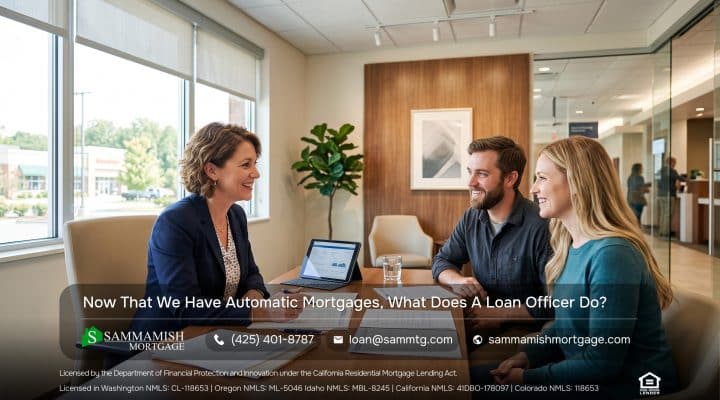
Our loan officers are ready and waiting to help you apply for your home loan.
Learn more about the people behind Sammamish Mortgage
Whether you’re buying a home or ready to refinance, our professionals can help.
Mortgage Support — 24/7
No Obligation and transparency 24/7. Instantly compare live rates and costs from our network of lenders across the country. Real-time accurate rates and closing costs for a variety of loan programs custom to your specific situation.
Adjust the parameters based on what you want to track




