

States We Lend In
Our loan officers are ready and waiting to help you apply for your home loan.


What credit score is needed to buy a house in Washington State? There is no single universal number. The minimum score depends on the loan program you use and the lender you choose, because lenders can apply stricter standards than the baseline program guidelines.
In practice, many borrowers start by looking at conventional loans around the low-600s, while some government-backed options may allow lower scores. But your credit score is only one part of the approval decision. Lenders also review your down payment, debt-to-income ratio, cash reserves, and recent credit behavior.
Keep in mind that lenders can set stricter requirements than these typical starting points.
When you apply for a home loan, the mortgage lender will review your finances to see if you’re capable of repaying the debt. They’ll consider your monthly income and assets, your recurring debts, and other aspects of your financial situation.
They’ll also look at your credit score, and this can partly determine whether or not you’re able to buy a home in Washington State.
Credit scores are three-digit numbers that give mortgage companies insight into how you’ve borrowed and repaid money in the past.
For example, a person who has always repaid his or her debts on time will likely have a high score. On the other hand, a person with a pattern of late payments and delinquencies will probably have a comparatively lower score.
Average credit score data can offer some general context, but it does not determine whether you can qualify for a mortgage. What matters more is how your score fits the loan program you want, whether your lender has stricter overlays, and how the rest of your financial profile looks.
For Washington home buyers, it helps to think about mortgage qualification in three layers. First, there are baseline program minimums, which vary by loan type. Second, there are lender overlays, which can require a higher score than the program itself. Third, there is your overall file, including your down payment, debt-to-income ratio, reserves, income stability, and recent credit behavior.
That is why there is no single credit score requirement that applies to every borrower. Many conventional borrowers begin around 620, while some government-backed options may be available with lower scores. But a lower score does not automatically mean denial, and a higher score does not guarantee approval if other parts of the application are weak.
If your score is near a program minimum, lender choice can matter a lot. Some lenders may be more flexible than others, while some may want stronger compensating factors such as more money down, lower overall debt, or extra reserves in the bank.
The minimum credit score you need to get approved for a mortgage in Washington State will depend on a few things, including the type of home loan you’re applying for. Generally speaking, here are the minimums needed for the following mortgage types:
A practical way to think about your next step is to match your approximate score range to the most likely path forward.
Credit is just one facet of the mortgage qualification process. Lenders look at other factors as well, including income stability and cash reserves.
The important thing is to avoid making assumptions about your ability to qualify for a home loan. The only way to find out if you’re qualified for mortgage financing is to speak to a lender. (Feel free to contact us, if you’d like.)
Mortgage companies tend to look at the “big picture” when reviewing loan applicants. Credit scores are just one part of that picture.
There are 5 main factors that influence your credit score according to the chart below:
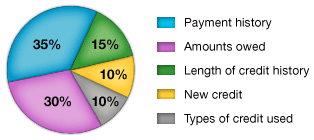
As you can see from the pie chart, your “payment history” accounts for 35% of your credit score under the FICO scoring model. That’s more than any other single factor. As a result, late and missed payments can seriously lower your score.
So, what can you do if you find out your credit score is too low to buy a home in Washington State? The good news is you’re not powerless. There are certain steps you can take to improve your credit score by taking the following steps:
The first, and possibly most important, step is to make sure you pay all of your bills on time going forward. Pay particular attention to the things that show up on your credit reports, like personal loans, credit cards, etc.
So pay those bills on time. Setting up payment reminders and enrolling in automatic bill payments are two ways to keep up with your bills.
According to myFICO.com (which is owned by the company that actually created the FICO scoring system), reducing the amount of debt you owe might also improve your score. Having too much debt relative to income can lower a person’s score.
Also, refrain from applying for too many loans within a short window of time. Every time a lender conducts a “hard inquiry” on your credit report to find out what your credit health is like, it can pull down your credit score, albeit temporarily.
You also want to minimize your credit utilization ratio, which you can do by making sure that you don’t spend any more than 30% of your credit card limit.
And if you have old credit accounts that are in good standing, don’t close them out, even if you don’t use them. These might be having a positive impact on your credit score.
Yes. Your credit score can affect not only whether you qualify, but also the mortgage interest rate you are offered. In general, stronger credit can improve pricing, while weaker credit can lead to a higher rate or fewer loan options.
Even a modest difference in rate can meaningfully change your monthly payment and the total cost of borrowing over time. That is why borrowers often benefit from comparing quotes, reviewing loan options carefully, and using a calculator or rate quote tool to see how pricing differences could affect the payment.
Because each lender uses its own pricing approach, the best move is to compare your actual options instead of relying on a generic example. If improving your score is realistic before you apply, that may also help you qualify for better pricing.
Sammamish Mortgage can help. We serve clients across Washington, Idaho, Colorado, Oregon, and California. Since 1992, we’ve been providing several mortgage programs and products with flexible qualification criteria to borrowers across the Pacific Northwest. Visit our website to get an instant rate quote or to use our online mortgage calculator. Or, reach out to us if you are ready to get pre-approved for a mortgage.
There is no single credit score requirement for buying a house in Washington State. The minimum depends on the loan program and the lender, since lenders can apply stricter standards than the baseline guidelines. Many conventional loans often start around 620, while some government-backed options may allow lower scores.
A good credit score is one that fits the loan program you want and the lender’s requirements. In many cases, borrowers with scores at or above common conventional minimums have more options, but approval still depends on factors like down payment, debt-to-income ratio, reserves, and recent credit behavior.
The minimum credit score varies by mortgage type and lender. Typical starting points mentioned here are around 620 for conventional loans, around 580 for FHA, often 640 for USDA, and commonly 700 or higher for jumbo loans. Lenders can set stricter requirements than these starting points.
It may be possible, depending on the loan type and lender. Some government-backed options, such as FHA, may allow scores around 580, but approval also depends on the rest of your financial profile, including your debt-to-income ratio, down payment, cash reserves, and recent credit history.
Many conventional loans often start around 620, but lenders may require a higher score through their own overlays. If your score is near that range, lender choice can matter because some lenders may want stronger compensating factors like more money down or additional reserves.
Yes. Minimum score expectations usually vary by loan type. Typical ranges mentioned here are around 580 for FHA, lender-dependent flexibility for VA, often around 640 for USDA, and commonly 700 or higher for jumbo loans.
Lenders review your credit score as part of the mortgage approval process, but this content does not explain a specific scoring method such as use of a middle score. The key point is that lenders also consider your income, debts, down payment, reserves, and recent credit behavior along with your score.
Possibly. A lower score does not automatically mean denial, because lenders look at the full file. Strong compensating factors such as more money down, lower overall debt, income stability, and extra reserves may help depending on the loan program and lender.
Helpful steps include paying bills on time, reducing overall debt, avoiding too many loan applications in a short period, keeping credit card usage below 30% of the limit, avoiding overspending, and keeping older accounts in good standing open when appropriate.
Yes. Credit score can affect both qualification and pricing. Stronger credit can improve the mortgage interest rate you are offered, while weaker credit may lead to a higher rate or fewer loan options.


Our loan officers are ready and waiting to help you apply for your home loan.
Learn more about the people behind Sammamish Mortgage
Whether you’re buying a home or ready to refinance, our professionals can help.
Mortgage Support — 24/7
No Obligation and transparency 24/7. Instantly compare live rates and costs from our network of lenders across the country. Real-time accurate rates and closing costs for a variety of loan programs custom to your specific situation.
Adjust the parameters based on what you want to track




